
Key Takeaways:
Definition and Basic Concept
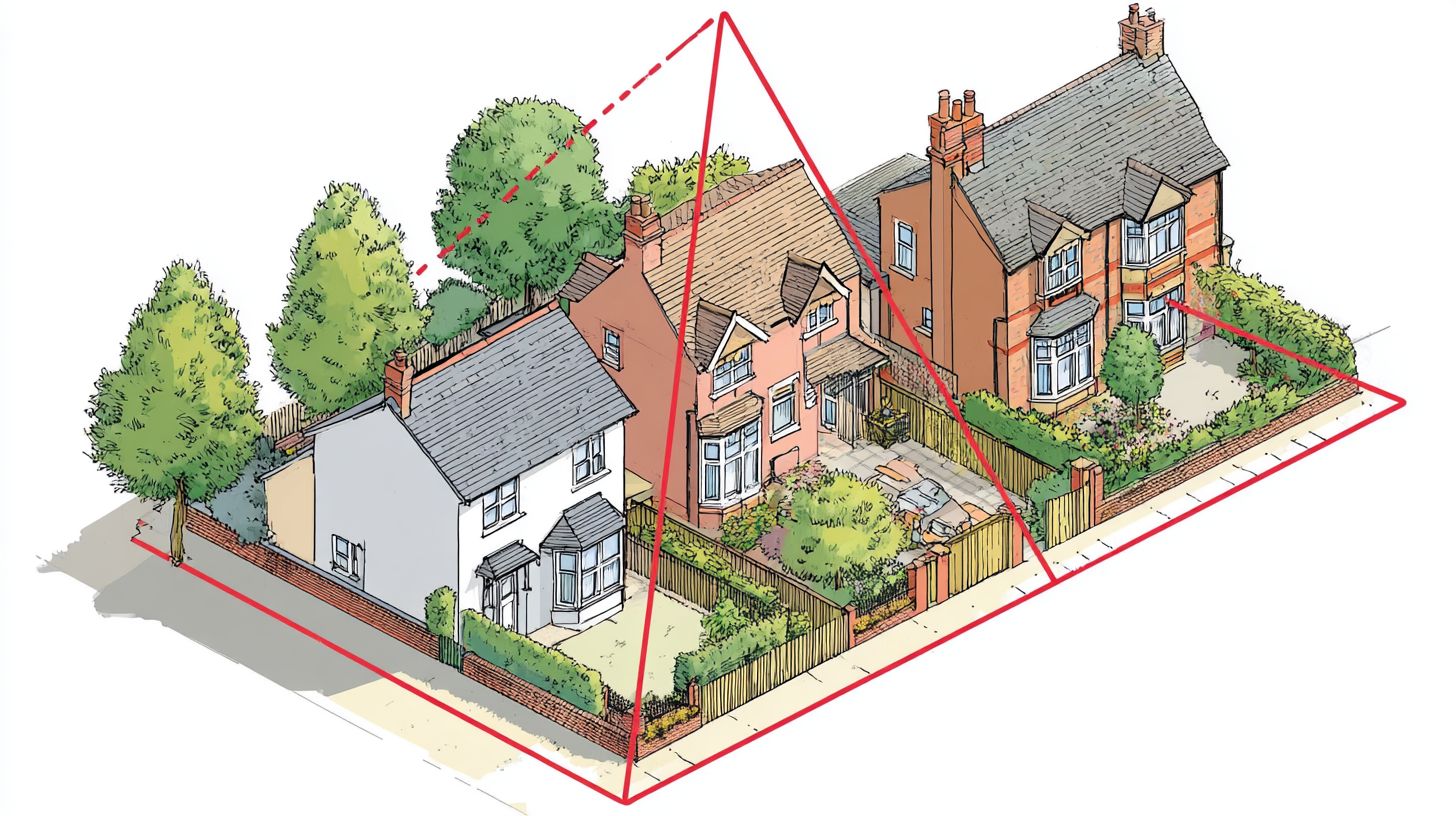
The 45-degree rule is an advisory guideline that no portion of a proposed home extension should encroach upon a 45-degree angle originating from the centre of the sill of the nearest habitable room window in an adjacent property, with the measurement typically taken from the boundary.
To illustrate this concept, consider a line drawn from the centre of the sill of a ground-floor window in a habitable room, extending at a 45-degree angle upward and outward from the neighbouring property. As detailed in the Building Research Establishment’s BRE209 guide (1991), this guideline pertains to windows in habitable rooms, with the objective of preserving adequate access to natural light.
For practical implementation, the maximum extension height or required setback can be determined through trigonometric calculation: at a 45-degree angle, the height is equivalent to the horizontal distance (since tan 45° = 1). Thus, for an extension reaching 3 metres in height, the minimum setback from the boundary must be 3 metres, thereby ensuring the structure remains beneath the angle line and adheres to applicable local planning regulations.
Historical Context in Building Regulations
The 45-degree rule developed from post-war planning policies under the Town and Country Planning Act 1947, whose foundational role in shaping modern planning—as explored by Historic England in their analysis The Rise and Fall of the 1947 Planning System—underwent significant evolution during the 1970s to address challenges posed by increasing urban density, as evidenced in Department for the Environment, Transport and the Regions (DETR) guidance and earlier DOE circulars.
The 1947 Act introduced general planning controls, including considerations for daylight and overshadowing in building designs, with the objective of mitigating issues in expanding post-war suburban landscapes.
A 1972 circular from the Department of the Environment (Circular 56/72) provided guidance on the 45-degree angle as a method to assess daylight, recommending that new developments should preserve access to daylight for neighbouring properties by measuring from the window sills.
This approach marked a transition from subjective evaluations of daylight—often subject to contention—to precise geometric criteria, thereby enhancing equity in the configuration of semi-detached housing arrangements.
Further guidance was provided through the 1991 publication of BRE 209, which outlined detailed methodologies for assessing daylight and sunlight, including the 45-degree rule and angle drawdown diagrams. [Discover our complete guide to planning and building regulations for conservatories in the UK](https://www.survdesign.co.uk/architectural-services/building-regulations-plans/conservatories/) to see practical applications of these principles in modern extensions.
Purpose of the Rule
The 45-degree rule is established to protect the quality of life and visual amenity within residential communities, primarily by prohibiting home extensions, such as kitchen extensions, that cast excessive shadows, have a negative sunlight impact, or impede views onto neighbouring properties.
Protecting Neighbouring Light and Privacy
The preservation of daylight access is a critical aspect of planning policy, designed to safeguard habitable rooms within neighbouring properties. Research, including BRE 209, indicates that significant reductions in natural light can impair occupant well-being.
This provision commonly aligns with the 45-degree rule and the complementary 25-degree rule used in UK planning assessments, which aim to ensure that extensions do not excessively obstruct the sky view in neighbours’ living rooms or kitchens. To ensure compliance, sightlines are typically measured from the centre of window sills at a height of approximately 0.8 to 1.05 metres, including an outlook assessment, with no major obstructions within the 45-degree angle.
In a documented case involving a terrace house in Birmingham, a non-compliant loft extension resulted in a 30% reduction in daylight, prompting a compensation claim of £5,000 from affected neighbours under private nuisance laws in England and Wales.
For practical implementation, professionals are advised to utilise free 3D modelling software to conduct preliminary daylight modelling. This enables simulation of potential impacts and verification that at least 27% sky visibility is maintained, in accordance with BRE guidelines, prior to formal submission. For those seeking a deeper dive into urban planning standards, the Daylight, Sunlight & Overshadowing Review from the Greater London Authority offers valuable insights on these assessments.
How the Rule Works
The 45-degree rule functions through rigorous geometric analysis to assess whether a proposed extension infringes upon a neighbour’s light cone. This principle is routinely applied to rear and side extensions to ensure compliance with planning regulations.
Measurement Guidelines

Measurements commence at the lowest window sill (typically 0.8 metres above the ground floor) of the nearest habitable room, from which a 45-degree line is drawn horizontally toward the proposed extension site.
To implement this requirement in accordance with UK planning guidelines, adhere to the following numbered steps:
- Identify the reference window, for instance, a kitchen in an adjacent semi-detached house located 10 metres away, confirming it qualifies as a habitable room in line with guidance from the Planning Portal.
- Measure the vertical measurement from the sill to the ridge of the extension, such as 2.5 metres, utilising a laser measuring device.
- Determine the horizontal measurement: as tan(45°) equals height divided by distance, the distance is equivalent to the height (a minimum setback of 2.5 metres).
- Depict the measurements on an elevation drawing, floor plan, and structural drawings using CAD software, at a scale of 1:50.
This procedure typically requires 30 to 60 minutes. A frequent error involves overlooking multiple windows; it is imperative to consult an architectural professional to evaluate all those within a 25-metre radius, particularly north facing, south facing, west facing, and east facing ones, to ensure full compliance. (92 words)
Application to Building Extensions
For a single-storey rear extension with a height of 3 metres, the applicable rule mandates a minimum setback of 3 metres from the rear wall to prevent breaching the 45-degree angle measured from a neighbour’s first-floor window. This 45-degree rule is designed to safeguard neighbours’ access to natural light in line with UK planning practices in England and Wales.
When considering extensions, it is advisable to evaluate them by type.
Rear extensions, including single storey extensions and those with a mezzanine level, may extend up to 4 metres under permitted development rights (Class A); however, compliance with the 45-degree angle must always be verified—for instance, a single-storey rear addition of 3 metres in depth requires a corresponding 3-metre gap from the boundary.
Side extensions necessitate careful examination of side boundary walls, particularly in corner plots, with a recommended 2-metre setback to mitigate issues related to eaves height.
Front extensions are seldom viable owing to restrictions on the building line.
In the case of a detached house, a two storey extension of 2.5 metres in height requires a 2.5-metre separation from boundaries.
For terraced houses, it is essential to refer to local authority design guides, such as those provided by Historic England, to maintain symmetry preservation and potentially avoid the need for full planning applications, especially for wrap-around extensions or those featuring bay windows.
Legal Framework
The 45-degree rule, as incorporated within the United Kingdom’s Town and Country Planning (General Permitted Development) Order 2015, establishes the criteria for determining whether proposed building extensions qualify for permitted development rights or require full planning permission.
UK Planning Permissions and Permitted Development
Under permitted development rights, as outlined in the UK government’s guidance on when permission is required, single-storey rear extensions extending up to 3 metres (for terraced properties) or 4 metres (for detached properties) may qualify for compliance provided they adhere to the 45-degree rule, thereby obviating the need for a full planning application, which incurs an average fee of £206 in England.
To verify eligibility under the General Permitted Development Order (GPDO) 2015, Classes A-E for extensions, the following steps are recommended:
- Conduct a self-assessment using the free interactive house tool on the Planning Portal, entering property details to evaluate compliance with height, depth, and boundary regulations.
- If compliant, submit an application for a Lawful Development Certificate (fee of £103 in England; fees may vary slightly in Wales) through the local planning authority to obtain official verification, which is essential for property resale.
- For complex sites, engage a RIBA-registered architect to prepare scaled drawings demonstrating adherence to the relevant criteria.
A common oversight involves disregarding Article 4 directions in conservation areas, which may necessitate full planning permission.
Exceptions and Variations
Exceptions to the 45 degree rule include provisions for rural workers’ structures and the 25 degree rule in certain scenarios. Variations may apply based on window orientations, such as north facing or south facing properties, and require careful consideration for west facing or east facing exposures. Joint planning with the local planning authority is advisable for complex projects like loft extensions at the mezzanine level or wrap-around extensions to ensure visual amenity, outlook assessment, and overall compliance with property law.
Although the 45-degree rule serves as the standard guideline, exceptions are permitted in certain circumstances, such as loft extensions or rural worker dwellings. In these cases, modified angles or waivers may be applied in accordance with prevailing local policies.
Special Cases for Height and Distance
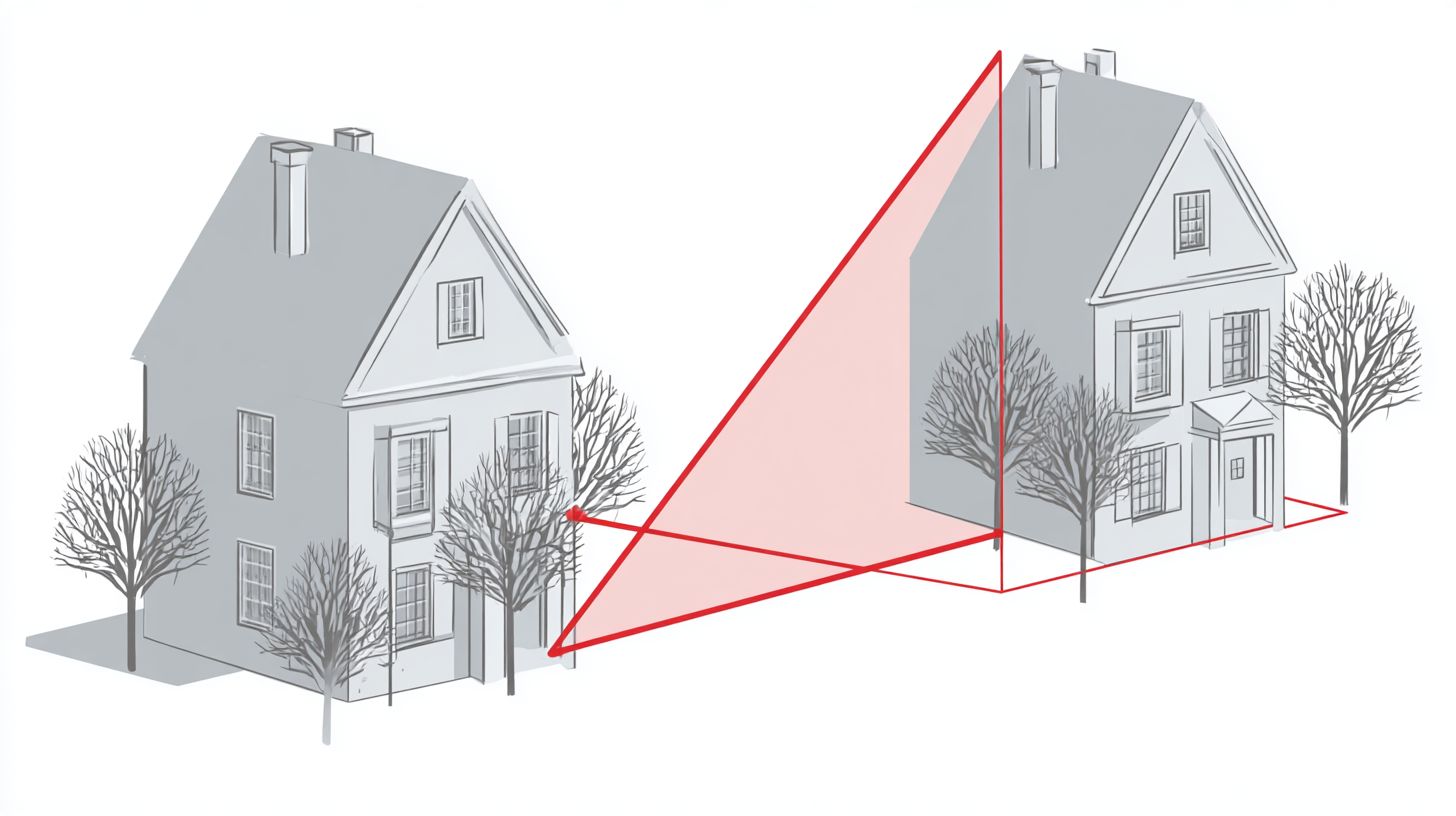
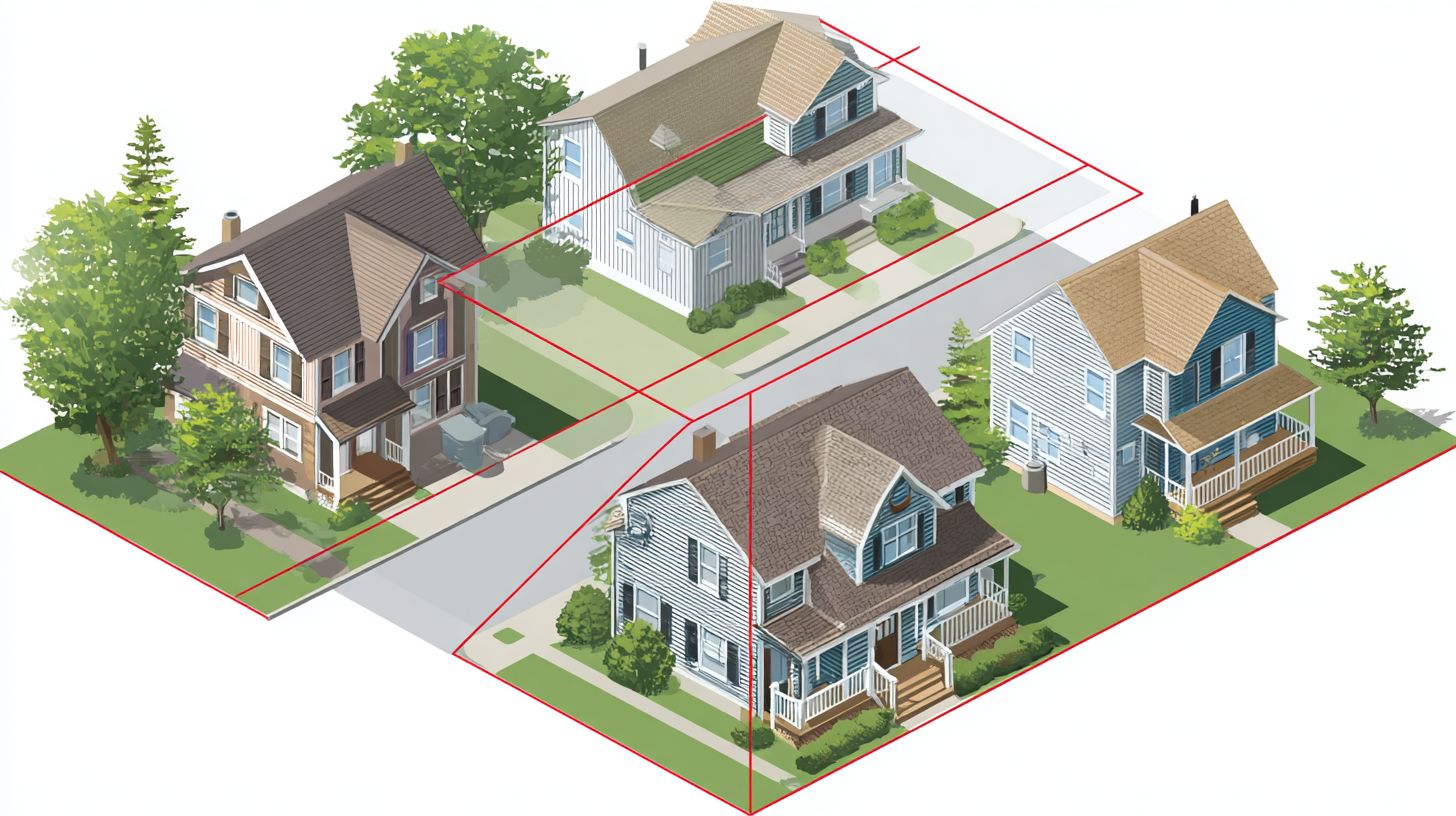
In corner plots, the 45-degree rule must be applied from each relevant boundary to assess impacts on neighbouring properties and ensure compliance with light and overshadowing guidelines.
To implement this provision effectively, delineate the 30-degree line from each boundary utilising site plans within software such as AutoCAD or Revit, while verifying that no overshadowing occurs beyond the defined angle.
Exceptions to these guidelines include:
- Mezzanine levels in loft conversions, provided they comply with volume limits and other criteria under Permitted Development Rights (typically allowing additional floor space without creating a full additional storey);
- Rural workers’ dwellings, which are exempt through agricultural prior approval (refer to PPG reference 030 and NPPF);
- Joint planning agreements with the local planning authority, where light access considerations may be addressed through pre-application discussions.
For sites with slopes, reference the BRE209 guidelines to modify vertical measurements accordingly.
Recommended action: Develop elevation drawings in Revit to model variations in setbacks and simulate potential light impacts; this initial setup typically requires 4 to 6 hours.
It is advisable to consult the local planning authority for validation specific to the site.
Practical Examples
In practical applications, the 45-degree rule frequently determines the viability of building extensions in urban environments, such as UK terrace houses, where spatial limitations underscore its critical importance.
Common Scenarios in Residential Extensions
In a south-facing semi-detached property in Birmingham, a 4-metre rear extension achieved compliance by being set back 3.5 metres from the boundary, thereby preserving the required 45-degree angle to the neighbour’s north-facing kitchen window. Comparable compliance approaches are applicable in various other scenarios.
- Case 1: For a terraced house, a side extension was restricted to a height of 2 metres and positioned 2 metres from the boundary, thereby mitigating potential objections from neighbours. A floor plan sketch illustrated an L-shaped layout that maintained the 45-degree angle (outcome: approval granted within 8 weeks).
- Case 2: In a detached corner-plot property, a wrap-around extension incorporated bay windows to stagger the heights (1.8 metres initially, rising to 3 metres), yielding an additional £20,000 return on investment. A straightforward U-plan sketch demonstrated the preserved views (outcome: improved kerb appeal, resulting in a 15% faster sale).
- Case 3: A two-storey front extension initially failed to meet the 45-degree rule, necessitating a redesign with a BRE209-compliant skylight at an additional cost of £1,500. The revised floor plan featured an angled roofline (outcome: permission granted following resubmission, in accordance with UK planning regulations).
Compliance and Best Practices
Compliance with the 45-degree rule can significantly improve approval rates through the early involvement of professionals and meticulous documentation.
To ensure successful outcomes, adhere to the following six best practices:
- Engage a RIBA-registered architect (fees typically ranging from £500 to £1,000) for initial assessments to identify potential breaches at an early stage.
- Employ 3D modelling software, such as SketchUp, to simulate light paths (with setup requiring under 1 hour), thereby visualising the rule’s impact.
- Submit detailed floor plans and elevations to planning authorities at an early juncture to obtain preliminary feedback.
- In borderline cases, incorporate skylights aligned with the 25-degree sunlight rule to mitigate shading effects.
- Conduct consultations with neighbours, which are recommended in many cases under UK guidelines, to pre-empt potential objections.
- Reference the BRE209 guidelines for timing considerations; perform assessments during the design stage to avoid fines of up to £20,000 for non-compliance.
These measures, aligned with RIBA and BRE standards, streamline the approval process and can reduce rework costs.
Related Rules and Alternatives
Along with the 45-degree rule, the 25-degree sunlight rule serves as a complementary guideline designed to protect access to winter sunlight. This rule is particularly applicable to east- and west-facing windows in building extensions.
To effectively compare these daylight rules, it is essential to examine their principal attributes, as summarised in the table below:
| Rule | Focus | Metric | Example |
|—————|——————————–|———————————————|———————————————-|
| 45-degree | Daylight (all orientations) | No development within 45° angle from window base | Side extension blocking neighbour’s kitchen view |
| 25-degree | Sunlight (Nov-Feb, per BRE209 guide) | At least 2 hours daily winter sun on window | Loft extension on south-facing roof preserving morning light |
| Right to Light | Legal easement | 20-year uninterrupted access (Prescription Act 1832) | Dispute over new build shading office windows |
For practical evaluation, vertical light meters—available for approximately £50—can be utilised to measure illuminance levels. Integrating these rules can promote more harmonious development outcomes.
It is recommended to consult local planning officers for site-specific applications.
Frequently Asked Questions
What is the 45 degree rule for extension?
The 45 degree rule for extension is a guideline used in planning policy, particularly in England and Wales, to ensure that new single-storey rear extensions do not excessively block natural light to neighboring properties. It states that the extension should not extend beyond an imaginary line drawn at a 45-degree angle from the center of the nearest ground-floor or first floor window of the adjacent house, measured from the rear wall of the original building.
How does the 45 degree rule for extension apply to my property?
The 45 degree rule for extension applies by drawing a line at 45 degrees from the midpoint of the closest habitable room window on the neighboring property’s rear elevation. Your extension must not project beyond this line to qualify for permitted development rights, helping to prevent disputes over light loss while allowing reasonable home improvements.
Why was the 45 degree rule for extension introduced?
The 45 degree rule for extension was introduced as part of planning policies to balance homeowners’ rights to extend their properties with the need to protect neighbors from significant reductions in daylight. It originated from older light obstruction rules and is now embedded in permitted development guidelines to simplify approvals without full planning permission.
Does the 45 degree rule for extension limit the height of my build?
While the 45 degree rule for extension primarily addresses the projection distance to avoid light blockage, it indirectly influences height because taller extensions could still breach the angle if they encroach on the 45-degree line. Typically, it focuses on plan view, but local authorities may consider overall impact, so heights are often capped at 3-4 meters for single-storey extensions.
Can I get planning permission if I violate the 45 degree rule for extension?
Yes, you can still apply for full planning permission if your extension violates the 45 degree rule for extension in England and Wales. Authorities will assess the proposal holistically, considering factors like the site’s specifics, neighbor consultations, and mitigation measures, though approval isn’t guaranteed and may require design adjustments.
What happens if my extension ignores the 45 degree rule for extension?
Ignoring the 45 degree rule for extension in England and Wales could lead to enforcement action from local planning authorities, including stop notices, fines, or requirements to demolish the unauthorized structure. It’s advisable to consult a professional or submit a lawful development certificate to confirm compliance and avoid costly legal issues.