
2 Storey Rear Extensions, Fully Explained
Two-Storey Rear Extensions: Planning, Building Regs, Structure, Neighbour Amenity & Cost — The Complete Guide
A two-storey rear extension can transform how a home works: bigger kitchen-diner with a utility and WC downstairs; extra bedrooms or a principal suite upstairs. Done well, it looks like it was always there, passes approvals cleanly, and adds real value. Done badly, it can fall foul of planning rules, overlook neighbours, or underperform thermally. This guide is your step-by-step map from idea to sign-off.
First Principles: What Makes a Good Two-Storey Extension?
Plan depth & proportion: Two storeys magnify mass. Keep depth disciplined and volumes well-proportioned to the original house.
Structural logic: Bigger openings need real beams, proper bearings, and temporary works sequencing.
Thermal continuity: Warm, airtight shell; junction details that kill cold bridges.
Neighbour amenity: Respect outlook, privacy, daylight and garden use; design to pass common tests before you draw elevations. This is perhaps just a critical as when designing a two storey side extension
Buildability: Access to the rear, spoil routes, scaffold, and weatherproofing during knock-throughs.
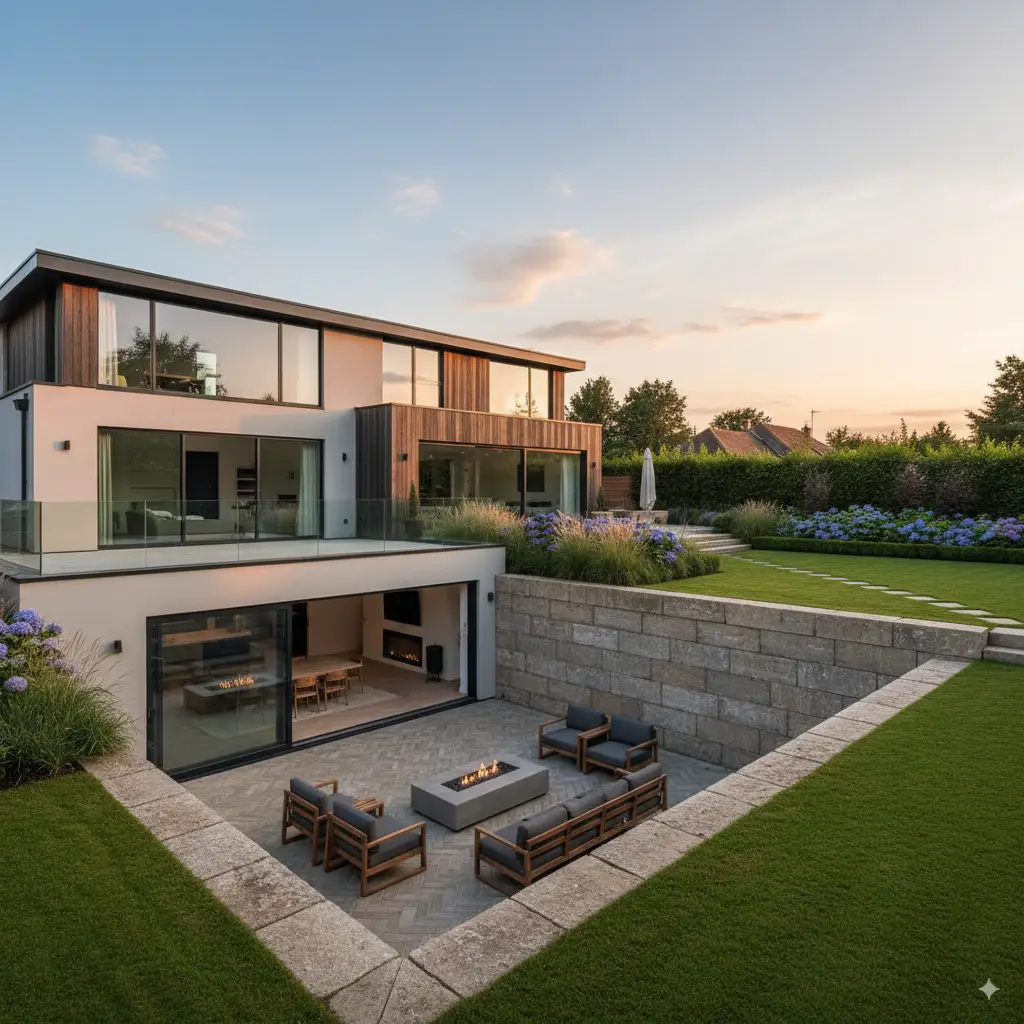
Planning Permission vs Permitted Development (PD)
Many two-storey rear extensions need planning permission. A limited class of two-storey rear extensions can be PD on houses (not flats/maisonettes), but the PD allowance is tight. Key PD ideas to understand before you design:
Depth limit: Under PD, a two-storey rear extension may project only a modest depth beyond the original rear wall (commonly up to 3 m). If you want more than that, you’ll need planning permission.
Rear boundary separation: PD typically requires a minimum separation from the rear boundary (often ≥7 m from the extension’s rear wall to the rear boundary).
Heights & roofs: Eaves and ridge must not exceed the existing house; roof pitch should match the existing dwelling.
Windows at upper floors: Any side-facing upper-floor window must be obscure-glazed, and openings restricted above a set sill height. Balconies/raised platforms are not PD.
Appearance: Materials should be similar to the existing house.
Designated land & Article 4: Conservation areas, National Parks, AONBs and Article 4 directions can remove or limit PD. Many streets with parking pressure or particular character have Article 4; assume nothing—check first.
Original house basis: PD measurements are taken from the original house (as first built or as at the relevant base date), not from a later extension.
If your brief exceeds PD depth or falls foul of any condition, a householder planning application is the right route. You still want the design to be neighbour-friendly and policy-aware.
Planning Permission: What Officers Will Look For
Scale & massing relative to the host dwelling and garden.
Neighbour amenity: overlooking, loss of daylight/sunlight, sense of enclosure.
Design & materials: roof form, window alignment, brick bonds, details that tie into the original house.
Parking & access where relevant (some districts care about on-plot spaces).
Trees & heritage if applicable.
Pro tip: Even when you’re confident it’s PD, a Lawful Development Certificate gives paper certainty for lenders/buyers later.
Neighbour Amenity: Design to Pass the Common Tests
Before drawing elevations, run these quick checks:
45-degree/25-degree tests: Many councils use a 45-degree test in plan and/or a 25-degree vertical test from your neighbour’s key windows to screen out harmful daylight loss. Sketch the tests early and adjust depth/roof if you fail them.
Outlook & enclosure: A two-storey wall too close to a neighbour’s window can create an overbearing feel. Step in at first floor, lower eaves locally, or chamfer/hip corners to soften mass.
Overlooking & privacy: Avoid direct line-of-sight into neighbours’ habitable rooms or main garden sitting areas. Use obscure glass to bathrooms/landings; consider oriel or high-level windows; avoid side balconies.
Garden usability: Keep decent garden depth after the extension; officers dislike leaving a postage stamp.
Architecture & Roof Forms That Behave
Match the main roof: a simple dual-pitch continuation with aligned ridge often reads best. Hipped returns and cat-slide roofs can reduce bulk near boundaries.
Step-back at first floor: the ground floor might project further; a set-back upper floor reduces mass and helps pass amenity tests.
Eaves lines & brickwork: continue string courses, bond patterns and sill heights so the eye reads one composition, not an add-on.
Openings: line through heads and cills with the original house; repeat rhythm, don’t sprinkle random windows.
Building Regulations — What Will Be Checked
A two-storey extension always triggers Building Regulations. Expect control over:
Part A (Structure): foundations sized to ground; beams/lintels sized for openings; stability of the remaining house after knock-throughs; lateral restraint and wall ties; bearing/ padstones; diaphragm action of floors/roof.
Part B (Fire): escape from first-floor rooms (Egress windows or a protected stair), fire-resisting doors/linings where required, cavity barriers and fire-stopping at junctions, separation to boundaries, and alarms.
Part C (Moisture): DPCs, DPMs, cavity trays, weeps, and detailing to avoid water tracking at abutments and parapets.
Part E (Sound): if semi-detached/terraced, acoustic performance of party elements; flanking control at new junctions.
Part F (Ventilation): background ventilation (trickle) and purge areas; extract to wet rooms; whole-dwelling rates if you’re making the house tighter.
Part H (Drainage): connection details, rodding points, and surface water management; any new manholes externalised.
Part K (Stairs & safety): guarding, geometry, balustrades; barriers at French doors/Juliets where needed.
Part L (Energy): U-value targets for walls/roof/floor, upgraded windows/doors, thermal bridging targets, and SAP/Area-weighted compliance for extensions.
Part M (Access): reasonable provision; thresholds & widths where relevant.
Part P (Electrics): notifiable works; certification required at completion.
.
Structure & Knock-Throughs: Beams, Bearings & Temporary Works
The magic moment is opening the back of the house to create an airy kitchen-diner. That means removing load-bearing walls and fitting beams:
RSJ/UB design: spans, loads (including the new upper storey and roof), and deflection limits all drive beam size.
Bearings & padstones: bearings typically 100 mm+ on sound masonry with padstones; check party walls and old chimney breasts.
Twin beams or flitch beams where depth is tight; posts/box frames around big openings; goalpost frames and even moment frames for large sliders.
Temporary works: needle props and careful sequencing to avoid cracks or movement during the knock-through.
Lateral stability: when big wall sections go, you must re-establish shear panels, straps, and ties so the house still resists wind.
Foundations: Trench, Deepened, Piles or Raft?
Two storeys add load. Choose foundations to match ground, trees and neighbours:
Standard trench-fill/strip: straightforward on competent ground with no trees; concrete to below frost and to refusal on made-up ground.
Deepened trench near trees or clay: expect deeper digs, more concrete, more spoil; check for root zones and consider alternatives.
Piled foundations with ground beams: excellent where trenches collapse, in high shrink/swell clays near trees, or where depth is excessive; less spoil, predictable programme.
Reinforced raft slab: spreads load across a larger area; good on variable ground; reduces deep excavation and can simplify thermal detailing.
Build-over risk: if a public sewer runs across the garden, assume you may need a build-over/near agreement and protective details; do not enclose manholes inside the footprint.
Set levels early: decide finished floor levels vs garden and thresholds; allow for insulation/screed build-ups and UFH if used.
External Walls & Junctions — Warm, Airtight, Condensation-Safe
Walls: modern cavity walls with full-fill mineral wool or partial-fill + internal lining; or go timber frame/SIPs if speed is key (coordinate with masonry house).
Thermal bridge control: insulated closers, cavity barriers, continuous insulation at floor-wall and wall-roof junctions; avoid cold sills and lintels.
Air tightness: smart membranes at ceilings and around steels; tape window perimeters; seal service penetrations.
Moisture management: cavity trays above openings, roof abutments and steel penetrations; weep holes where required; breathable build-ups where moisture risk exists.
What a Good Drawing Pack Includes
A complete conservatory drawing pack typically includes existing and proposed plans, elevations and sections at appropriate scales; a roof plan; a site plan with boundaries and access; and concise materials notes. For Building Regulations, add general arrangement drawings with structural notes, insulation build-ups, glazing specifications, ventilation targets, and any fire and access notes required by the design.
If the Party Wall Act is engaged, foundation sections and clear setting-out dimensions help the neighbour’s surveyor understand the proposal. If a build-over or build-near application is needed, provide plans that show the sewer route and protective details, along with a section demonstrating how loads are kept off the pipe and how access will be maintained.
Where trees are a factor, include notes on soil type (if known), any recommended foundation depth or type, and a clear statement of assumptions. If an arboricultural input is needed, flag that early so the programme reflects it. The better your drawings, the fewer queries from approvals bodies and contractors, and the smoother your build will be.
.
Roofs That Don’t Leak — and Look Right
Pitched continuation: extend the main roof with matching pitch and tiles; tie valleys/hips cleanly.
Lean-to (cat-slide): lower eaves to manage massing next to a neighbour; make sure the pitch and coverings meet manufacturer minimums.
Flat roof (where design demands): use a warm roof with proper falls, high-quality waterproofing, and robust upstands; choose internal/external gutters with access for maintenance.
Rooflights: wonderful for internal daylight; detail kerbs and vapour control to stop condensation.
Drainage: size gutters/downpipes; plan overflows and leaf management.
Windows, Doors & Daylight: Liveable First, Pretty Second
Proportion & alignment: align heads/sills to the original house; repeat rhythms.
Glazing performance: low-E double/triple glazing; consider solar control for large south/west panes.
Ventilation: trickle vents + openable lights for purge; allow cross-flow.
Large sliders/bifolds: coordinate beam depths and thresholds; protect with canopies or deep reveals if the elevation is weather-beaten.
Privacy: obscure glass to bathrooms/landing; oriel/high-level windows on sensitive sides.
Services & Comfort: Heating, Ventilation, Hot Water, Electrics
- Heating: extend existing circuits (check boiler/heat-pump capacity) or create UFH zones downstairs with responsive controls.
- Ventilation: cooker hood to outside; extract to wet rooms; consider MEV/MVHR if the house is being tightened significantly.
- Hot water: extra bathrooms need HW capacity; check cylinder size or combi outputs.
- Electrics: new circuits are notifiable; plan socket counts, lighting layers, island power, and data for home working.
- Acoustics: mineral wool in internal partitions and between floors for a quieter, higher-quality feel.
Drainage, SuDS & Rainwater
Foul water: keep runs short and graded; provide rodding access; relocate any internal manholes outside the footprint; coordinate new stacks/vents.
Surface water: add soakaways or connect to the surface system per local rules; permeable paving and rain-garden planters help with SuDS.
Flat roof outlets: avoid long, hidden internal runs; provide accessible leaf guards.
Party Wall etc. Act 1996 — Don’t Leave It Late
Two storeys usually mean deeper foundations and work near shared walls:
Excavation notices: within 3 m (and deeper than neighbour’s foundation), or within 6 m where your deeper foundations fall within specific angles to theirs.
Line of junction/new wall on boundary: notifiable.
Works to a party wall: cutting in steel, raising, or inserting flashings.
Serve the right notices on time, attach drawings and sections, and be ready with foundation details. If neighbours dissent, surveyors agree an Award; build your programme with that in mind.
Fire & Escape — Especially at First Floor
- Escape from bedrooms: either egress windows of adequate size/height or a protected stair route to a final exit.
- Internal linings & doors: upgraded linings/FD doors where required by layout; self-closers where specified.
- Detection: interlinked smoke/heat alarms.
- Boundary separation: wall/roof materials and openings may be limited near boundaries; consult the separation distance and fire-spreading rules during design, not on site.
Energy, Overheating & Daylight
U-values: meet or better current targets for walls, roof, floors; good windows/doors.
Thermal bridges: treat junctions; consider a Thermal Bridge Report where beneficial.
Airtightness: a simple air barrier strategy pays back forever.
Overheating: though full Part O applies to new dwellings, a highly glazed extension can still overheat; design for orientation, shading, cross-ventilation and consider solar-control glass.
Daylight strategy: rooflights over the middle of plan, high-level windows to throw light deep, and light finishes to lift reflectance.
Costs, Timelines & Procurement
Indicative programme
Survey, concept & planning: 4–10 weeks (add ~8 weeks for a planning decision if needed).
Technical design & Building Control: 2–6 weeks (faster on experienced routes).
Build on site: 10–20+ weeks depending on complexity, weather, and finishes.
Cost drivers
Foundation type (deep trench vs piles/raft), steelwork scale, glazing size/spec, roof form, number of bathrooms, kitchen level, and finishes.
Hidden drivers: drainage diversions, build-over protection, asbestos removal, brick matching.
Procurement
Traditional tender to builders with drawings/specs, or a design-and-build route with clear employer’s requirements.
Insist on named products/performance criteria, programme with milestones, and a variation process.
Step-by-Step Workflow We Recommend
Feasibility & constraints check — PD vs planning, Article 4, conservation, trees, sewers, parking, and neighbour tests.
Measured survey — accurate plans/levels; note openings, services, manholes.
Concept options — plan depth, roof form, window rhythm; run amenity tests.
Planning/LDC — choose the right route; assemble a clean, policy-aware pack.
Structural design — beams, bearings, temporary works; foundation strategy (trench, piles/raft).
Technical design — junctions, moisture management, U-values, ventilation; drainage & services schemes.
Party Wall & build-over — serve notices and apply early if needed.
Tender/contract — fixed scope with schedules and drawings; start on paper.
Build & inspections — photograph membranes/insulation/steel bearings before covering; keep certificates.
Completion — snag, obtain Building Control completion, and file your pack (certs, warranties, manuals, as-builts).
FAQs
Can a two-storey rear extension be built under PD?
Sometimes, but the depth is tightly limited and there are strict conditions (including distance to rear boundary). Many two-storey schemes are planning applications.
Do I need neighbours’ permission?
Not for planning, but the Party Wall Act may require formal notices if you’re close to/below their foundations or working on a party wall.
Will Building Regulations require me to upgrade the whole house?
You must make the extension compliant and avoid making the existing house worse. Some upgrades to the existing fabric/services may be triggered to meet overall standards.
What about right-to-light?
Right-to-light is a separate civil matter (not the same as planning daylight tests). Designing to pass the planning tests reduces risk; seek specialist advice if very tight.
How long does it take?
Allow weeks for design/approvals and several months on site. Lead times for windows and steels often control programme.

Quick Links
Get In Touch
Building 13, Thames Enterprise Centre, Princess Margaret Road, East Tilbury, Essex, RM18 8RH
- Phone: 0800 494 7023
- Hours: Mon-Fri 8:30AM - 5:30PM
Get In Touch
Building 13, Thames Enterprise Centre, Princess Margaret Road, East Tilbury, Essex, RM18 8RH
- Phone: 0800 494 7023
- Hours: Mon-Fri 8:30AM - 5:30PM